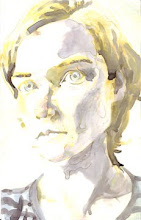


This post is not about how to do traditional scratchboard. For great scratchboard tutorials that will teach you to do the kind of photo-real linework you expect from scratchboard, check out http://www.scratchboard.org. This post is about how to use ink to achieve some more tonal, painterly, messy or expressive effects. This post is about how to weird up your scratch art.
I don't know what kind of ink you use. I use Sumi, 'cause i like the consistency and the thick satiny coverage, and, more importantly, it's what i had on my desk. What i'm about to describe would probably work with any water-soluable ink, but i know for sure it works with Sumi.
1. Line weight
Traditional scratchboard uses a sharp tool, often a stylus, to scratch lines of a consistent width into a layer of ink, revealing the clay underneath. Cool. But the stylus only gets you one width of line, yielding an etched, rapidograph look. Which is awesome if you want that, but by simply switching to a broader tool, like a #11 X-Acto blade, you can scrape away a larger area, giving you a variety of line widths from thin stylus to fat scrapey. Check it out:

Mix the fat scrapes with precise stylus values for a full range of precision and expressiveness. All your marks are pretty earthy, though, hard or gritty or scrapey. So how you gonna soften it a little?
2: Wet it up.
Use a wet brush to moisten an area and brush away the topmost layer of ink. While the clayboard feels pretty smooth, it's actually full of tiny pits and peaks. The ink will rub off the peaks first, giving you a sparkly, silty, soft-edged value shape. You can move the ink you just wiped off to another area, bringing down something that's too light or softening something that's too harsh. Be warned, though, ink's not all the water dissolves. A little of the clay comes with it, and the resultant mixture is slightly paler and more matte than the raw ink areas. If you're watching for it, you can use it to lighten areas without scratching them. If you're not watching for it it'll mess with your game, make areas read wrong. In my drawing it flattened an area that should have read as dimensional, and made dimensional another area that should have lain flat. If the clay effect troubles you, just brush matte medium over the offending area- that gives you a level playing field. You can still scratch through it, although your lines will be a little grittier. Not surprisingly, you can't use water to lift ink off a matte mediumed area.

You can also use water in the ink just like you would with wet-on-wet watercolor. Aces.


